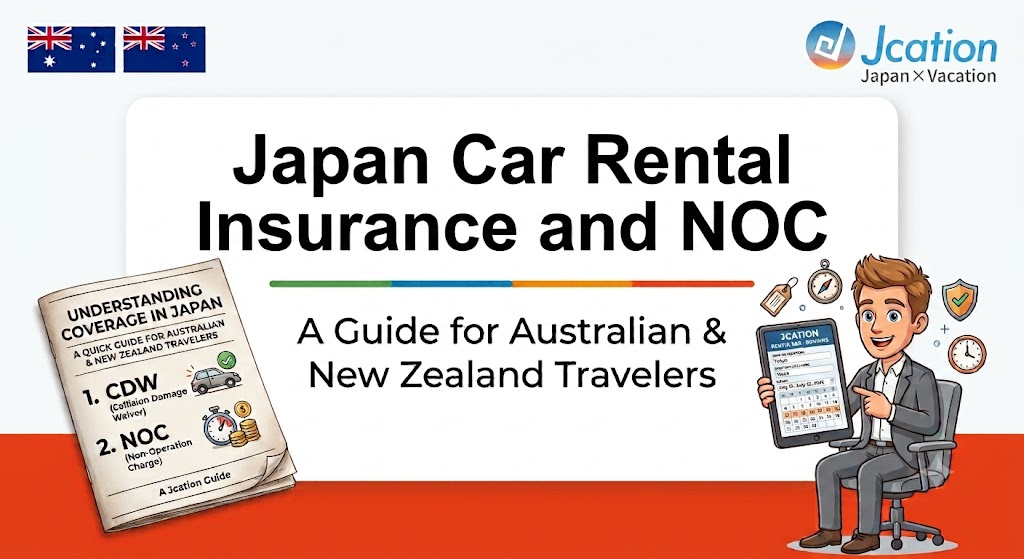
Planning a trip to Japan from Australia or New Zealand? Renting a car offers unparalleled freedom to explore Japan’s breathtaking landscapes and hidden gems at your own pace. However, for drivers accustomed to the straightforward "Excess $0" car rental experience in AU/NZ, stepping into the world of Japanese rental car insurance can feel confusing and overwhelming.
Terms like "CDW," "NOC," and a dizzying array of optional packages leave many travelers wondering: "Which plan actually gives me true peace of mind without hidden fees or surprise charges later?"
To help you avoid frustrating pitfalls—like unexpected charges at the rental counter or surprise bills over minor scratches—this guide breaks down the true mechanics of Japanese rental car insurance and shows you how to secure a smooth, stress-free drive across Japan.
The Basics of Rental Car Insurance in Japan: What Do You Need to Get "Excess $0"?
When renting a car in the Oceania region, simply selecting "Excess $0" (full cover) generally means literally zero out-of-pocket expenses in the unlikely event of an accident. However, the Japanese rental car insurance structure is slightly different, requiring a combination of "two different types of coverage."
What is the Basic "CDW" (Collision Damage Waiver)?
One term you will always see at Japanese rental car companies is "CDW (Collision Damage Waiver)."
Basic insurance is included in the Japanese rental car fee from the start, but there is a deductible (usually totaling around 100,000 JPY: 50,000 JPY for property damage and 50,000 JPY for vehicle damage) that the user must pay if an accident occurs. The CDW waives the payment of this maximum 100,000 JPY deductible. Joining this eliminates your out-of-pocket expenses for the car's repair costs, but this alone still leaves another risk.
What is Japan's Unique System, the "NOC" (Non-Operation Charge)?
Even if you have CDW, you may be billed separately for a uniquely Japanese fee called the "NOC (Non-Operation Charge)."
This is a flat-rate compensation fee for the rental car company's loss of business during the period the car cannot be rented to other customers because it requires repairs or cleaning due to an accident, self-inflicted damage, or significant interior soiling. A flat fee of 20,000 JPY applies if the car can still be driven back to the store, and 50,000 JPY applies if it requires a tow truck.
In short, to achieve a "zero out-of-pocket" status with a Japanese rental car, you must add coverage that includes this NOC in addition to the CDW.
Important - The True Meaning of "Excess $0" Achievable in Japan
In Australia and New Zealand, "Excess $0" often gives the impression of "absolutely zero out-of-pocket expenses no matter what happens." However, "zero out-of-pocket" in Japanese rental car insurance strictly means that "out-of-pocket expenses for 'vehicle repair costs (CDW)' and 'business compensation (NOC)' resulting from accidents or scratches will be zero."
While combining "CDW + NOC coverage" completely prevents the risk of expensive billing during an accident, please be aware that the following cases are often excluded from insurance coverage (and billed at actual cost) under the terms and conditions of standard Japanese rental car companies:
- Flat or burst tires
- Lost keys, or call-out/creation fees for locking keys inside the car (in-lock)
- Dead battery due to leaving headlights on (customer negligence)
- Significant soiling of the interior (e.g., smoking in a non-smoking car, pet accidents)
Just knowing about these exceptions in advance will reliably prevent later frustrations such as, "I thought it was Excess $0, but I still got charged."
As you can see, the Japanese rental car insurance system has a "two-tier" structure, which differs significantly from the simple full coverage in the Oceania region. If you aren't aware of this gap beforehand, your highly anticipated trip to Japan can become stressful right from the booking stage.
From here, let's take a closer look at the "3 specific concerns" that Australian and New Zealand residents often face when booking or using a car, and Jcation's reliable approach to preemptively resolving them.
① Option Overload: "Which Coverage Actually Gives Me Excess $0?"
On overseas booking sites, you just check "Excess $0" on the coverage selection screen and you're done. However, when you open a Japanese rental car company's website, the options are finely divided into "CDW," "NOC Coverage," "Safety Pack," "Roadside Assistance," and more. Many people feel intense stress right from the booking stage because they aren't sure which combination provides complete peace of mind.
Jcation's Solution: "CDW Included" and Simple Selection to Prevent Confusion
At Jcation, we have adopted a uniquely simple booking flow so that residents of Australia and New Zealand don't have to get lost in Japan's complex system.
All rental car plans listed on our site include tax and CDW from the start, so your out-of-pocket expenses for property and vehicle deductibles (up to 100,000 JPY) in the event of an accident are already waived at the base level. You don't have to worry about opaque, mandatory options being added before you complete your web booking.
Furthermore, if you want a complete full-cover state with no additional costs locally (Excess $0 at the time of an accident), you can smartly complete the process without hesitation simply by selecting a plan with NOC included or checking the recommended option on the booking screen.
② The CDW Trap: Why Repair Coverage Doesn't Save You from Business Loss Fees
Many users return the car thinking, "I'm safe because I have CDW," only to be shocked when the store staff charges them tens of thousands of yen for NOC. They feel it's unreasonable, thinking, "I shouldn't have to pay for repairs, so why do I have to pay money?"
As mentioned earlier, CDW covers the repair costs, while the NOC (20,000 to 50,000 JPY)—which is compensation for the rental car company's loss of business—is billed separately. This is a standard rule in Japan.
Jcation's Solution: Clear Online Selection - Eliminating Counter Surprises
On typical rental car company websites and budget booking sites, the explanation regarding NOC is often written in small print in an inconspicuous place during web booking. Consequently, customers are often pitched, "What do you want to do about NOC coverage?" verbally for the first time at the store counter after arriving in Japan. Being forced to pay additional fees on the spot while trying to understand complex explanations after a long, tiring trip is a heavy burden.
At Jcation, we provide a system where you can clearly select and confirm the presence or absence of NOC coverage at the web booking stage. Since you can finalize your booking fully satisfied with the total amount and coverage scope beforehand, you will never be surprised by "unexpected charges" locally.
③ The Compliance Trap: No Police Certificate Means Zero Insurance Payout
In the Oceania region, if you get a minor scratch, like slightly scraping a wall in a parking lot, it's not uncommon to simply say, "I scratched it here" when returning the car, sign the full-cover paperwork, and be done with it. However, keeping this mindset in Japan can lead to an irreversible situation.
Without a "Police Accident Certificate," All Insurance and Coverage Are Invalid
In Japan, even for the most minor self-inflicted accidents (e.g., slightly scraping a guardrail, hitting a pillar in a parking lot) or single-car accidents with no other party involved, calling the police immediately on the spot and obtaining an accident certificate (treated as a traffic accident) is an absolute condition for insurance coverage. This is a highly strict rule under Japanese law (Road Traffic Act) and insurance company regulations.
If you neglect to contact the police thinking, "It's not a big scratch, I'll just tell them when I return it," even if you have the most comprehensive full-cover plan (CDW + NOC coverage), it becomes a breach of contract, and the insurance will not pay a single yen. As a result, you will end up facing the worst-case scenario: paying the full repair costs, which can range from tens to hundreds of thousands of yen, entirely out of your own pocket.
Jcation's Solution: Selecting Reliable Premium Partners and Providing Secure Support
To protect our customers from Japan's uniquely strict operational rules, Jcation places the utmost importance on the quality of our partner companies.
We only list major, premium domestic brands that are members of their respective prefectural rental car associations or have cleared similarly strict proprietary standards. In the unlikely event of trouble or an accident, local professional staff will provide kind and accurate support in accordance with Japanese rules, minimizing the risk of Australian and New Zealand travelers suffering disadvantages or being unsure of what to do.
Head-to-Head: Jcation vs. Other Rental Car Sites
The Japanese rental car system may seem complex, but where you book completely changes your peace of mind during your trip.
| Item | Jcation | Other Rental Car Sites |
|---|---|---|
| Price Transparency | Clear Pricing All listed plans "include tax" and "CDW." You never have to worry about unexpected costs being added later. | Even if it looks cheap at booking, CDW is often charged separately, causing the total cost to jump significantly at the local counter. |
| Handling of NOC | Easy & Convenient Simply select a "Plan with NOC Coverage" or check Jcation's recommended option at booking to smartly set up an "Excess $0 for accidents" environment online. | At the reception counter on the day, you are verbally recommended to add "NOC coverage" along with complex terms in English, often leaving you confused about how much to pay for complete peace of mind. |
| Vehicle Quality & Safety | Safe & Secure Limited in principle to "high-quality vehicles registered as new within the last 4 years." Features well-maintained, clean vehicles, primarily from major domestic brands. | In exchange for cheap rates, you may receive older vehicles or vehicles with very high mileage, increasing the risk of trouble and discomfort during your trip. |
| Booking Simplicity | Easy & Convenient No bothersome membership registration is required. Booking is completed instantly by simply entering the necessary information. Excellent coverage from airports and major train stations. | You are frequently required to complete detailed membership registration in English and agree to difficult-to-read Japanese terms of use multiple times. |
Understand Japan's Unique Rules for a Safe Driving Trip
If you are accustomed to the generous and simple systems of Australia and New Zealand, the two-tier structure of Japan's "CDW" and "NOC," along with the rules requiring police notification even for minor scratches, might initially seem very strict. However, as long as you correctly understand the system and prepare accordingly, there is absolutely nothing to fear.
The key to achieving "Excess $0" (zero out-of-pocket expenses) for accidents and troubles in Japan, just like overseas, comes down to just two things: choosing a plan or option that includes both CDW and NOC coverage when booking through Jcation, and making sure to call the police and the rental car company on the spot in the unlikely event of an accident, no matter how small the scratch.
At Jcation, all plans include CDW from the start, and we strictly select only top-class domestic premium vehicles, generally "registered as new within the last 4 years." With the backing of our clear pricing and reliable safety, please enjoy your driving trip around Japan to your heart's content, exploring nostalgic landscapes and beautiful seasons.