Those who are used to renting cars in North America (such as the US or Canada) often find themselves confused or anxious when faced with Japan's unique insurance system and strict rules. Renting a car without knowing these differences can lead to unexpected charges at the rental counter or major trouble if an accident occurs.
In this article, we break down the basic insurance system and the "3 major hurdles" that North American residents frequently encounter when renting a car in Japan. Here is your smart guide to enjoying a drive in Japan with 100% peace of mind, free from fears of unexpected expenses.
The Basics First: What Do "CDW" and "NOC" Mean in Japan?
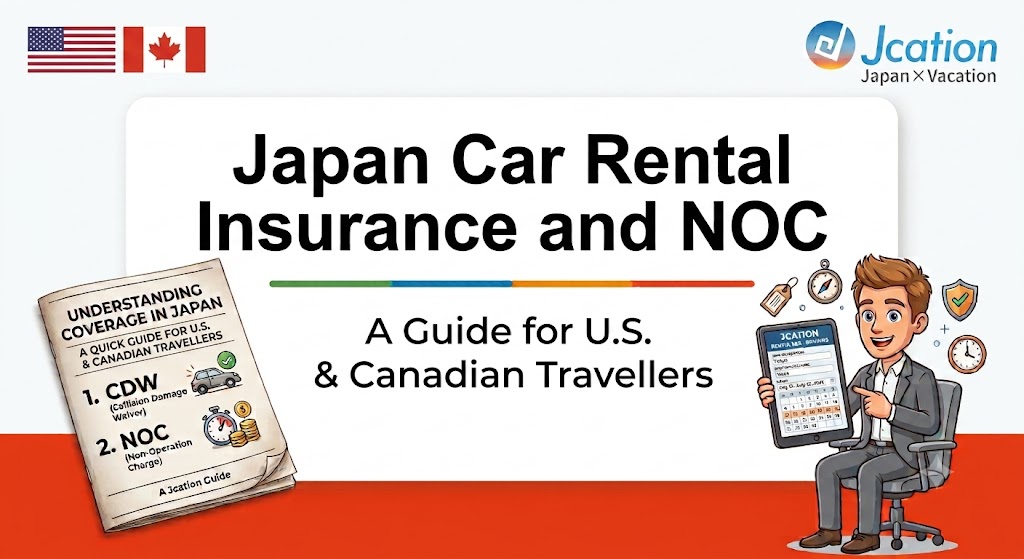
Before looking at the differences from North American rules, let's go over the two key concepts in Japanese car rentals: Collision Damage Waiver (CDW) and Non-Operation Charge (NOC). These represent completely different fees and are the most important points for driving safely in Japan.
What is Collision Damage Waiver (CDW)?
When you rent a car in Japan, basic coverage for Third-Party Liability, Personal Injury, and Vehicle Damage is generally included in the base rate. However, if an accident occurs, there is an out-of-pocket amount (deductible/excess) that the customer must pay (typically up to 50,000 JPY for property damage and 50,000 JPY for vehicle damage).
The option that waives this deductible (up to 100,000 JPY in total) so your out-of-pocket cost is zero is called "CDW" (Collision Damage Waiver / Menseki Hoshō).
What is Non-Operation Charge (NOC)?
You might think you are completely covered with CDW, but Japan has another unique fee: the Non-Operation Charge (NOC / Loss of Use).
If the car requires repairs or deep cleaning due to an accident, damage, or severe mess, the rental company cannot rent the car to the next customer. NOC is a standardized fee charged to the customer as business interruption compensation for that downtime.
- If the car can be driven back to the branch: 20,000 JPY
- If the car cannot be driven and requires towing: 50,000 JPY
In Japan, even if you have CDW, if you do not have the separate option that waives NOC (NOC Protection / Coverage), you will still have to pay 20,000 to 50,000 JPY out of pocket in the event of an incident. Requiring this "double layer of protection" is the biggest characteristic of renting a car in Japan.
Where North American "Reasonable Rules" Meet Japanese "Strict Rules"
Do you have a clearer picture of how Japanese CDW and NOC work?
You might be wondering, "I understand the mechanism, but how is it so different from renting in North America?" The truth is, if you try to rent a car in Japan with the mindset and "common sense" of driving in the US or Canada, these unique systems become unexpected pitfalls.
North America relies on reasonable, streamlined systems—such as "credit card insurance covers everything" and "minor scratches are brushed off as normal wear and tear." In contrast, Japan enforces a very strict system featuring "unique double-coverage options" and treating even a "1-centimeter scratch as an official accident." This gap in culture and perception is precisely what causes trouble for visitors from abroad.
Let us walk you through the 3 specific hurdles that North American residents often face the moment they land in Japan, along with smart ways to avoid them.
① Myth: "My Credit Card Covers Japanese Rental Insurance"
In the US and Canada, using rental car coverage (Primary/Secondary Insurance) included with premium credit cards (like Chase or Amex) to decline the rental company's CDW is a standard money-saving strategy. However, this rule of thumb generally does NOT apply to car rentals in Japan.
Can North American Credit Card Insurance Be Used for Japanese Rentals?
Most credit card rental insurance policies issued in North America exclude coverage for accidents in Japan, or require you to handle complex paperwork in English after returning home (such as submitting official police accident reports formatted under Japanese law).
Furthermore, Japanese rental car companies do not negotiate directly with overseas credit card providers. Therefore, if an accident occurs, you will have to pay the full amount out of pocket first on-site and attempt to claim reimbursement later.
Unexpected Counter Charges at Pickup
On generic discount rental booking sites in Japan, the basic rate may look cheap at first glance. However, CDW is often not included. When you arrive at the airport or local branch counter, you may be told, "CDW is an extra fee of X thousand yen per day," causing your final total to far exceed your budget.
Jcation's Solution: CDW is Included in Every Plan from the Start
To eliminate these unexpected surprises at the counter, Jcation displays all plans with Collision Damage Waiver (CDW) and consumption tax included from the start.
We practice Transparent Pricing, meaning the price you see on the website serves as your clear baseline, with no pressure to add unnecessary insurance options at the counter.
(Note: Excludes optional items added voluntarily by the customer on-site, such as ETC card rentals or child seats.)
② The Mysterious "NOC" Fee That Doesn't Exist in North America
As mentioned earlier, the Japanese rental industry's unique NOC is the fee that confuses North American residents the most.
Driving on the Left & Narrow Roads Increase Your Risk
If you are used to driving on the right side in wide North American lanes with left-hand drive vehicles, driving on the left side of narrow Japanese streets or backing into tight parking spaces significantly increases the risk of accidentally scraping wheels or bumpers on the passenger side.
In the US, you might think, "I have CDW, so a minor scratch is fine." In Japan, however, if a scratch requires repair, it triggers an NOC charge regardless of how small it is.
Jcation's Solution: Securing NOC Protection is Easy and Done 100% Online
On Jcation, you can easily secure NOC Protection to waive out-of-pocket NOC costs online.
You can choose a plan with NOC included at a glance, or easily add NOC Protection as an optional add-on during checkout for plans that don't include it by default. Even if you accidentally scrape a car on unfamiliar Japanese roads, your out-of-pocket costs will be reduced to zero, letting you focus entirely on enjoying your drive.
③ The Unforgiving Rule — "Call the Police Even for a Tiny Scratch"
When returning a rental car in North America, minor scratches of a few centimeters, rock chips, or scuffs are usually treated as normal "Wear and Tear" and ignored. In Japan, the rules are extremely strict.
Scratches Ignored in the US Require a Police Call in Japan
In Japan, whether you barely brushed a guardrail or lightly scraped a wheel against a curb, even a 1-centimeter scratch is legally classified as a traffic accident. You are legally obligated to call the police immediately at the scene to obtain an Official Police Accident Report (Jiko Shōmeisho) and report it to the rental company.
Without a Police Report, All Insurance and Coverage Become Void
If you decide, "It's just a tiny scratch, I'll mention it when I return the car," and leave the scene, all insurance coverage (including CDW and NOC Protection) becomes completely VOID. As a result, you will be held 100% personally responsible for all repair costs and business loss charges, which can run into tens or hundreds of thousands of yen.
No matter how minor the scratch seems, always call the police on the spot immediately. This is an absolute rule in Japan.
Jcation's Solution: Limited to Top Japanese & Reputable Brands (Safe & Secure)
Jcation only lists rental companies that meet the strict quality standards of local Rental Car Associations across Japan, focusing on major, highly reputable brands.
If an incident occurs and you need to contact the police or the rental company, 24/7 roadside assistance and dedicated customer support (in Japanese and English) are available. Even if you are unfamiliar with handling procedures in Japan, you can rely on full, reliable support.
Head-to-Head: Jcation vs. Other Rental Car Sites
To ensure you don't regret your choice after arriving in Japan, here is a clear comparison between Jcation and generic discount booking websites:
| Item | Jcation | Other Rental Car Sites |
|---|---|---|
| Price Transparency | All plans include CDW and tax upfront. The price you see online is what you pay, with no unexpected upselling at the counter. | Base rates look cheap, but CDW and tax are added separately, causing the final total at the counter to jump unexpectedly. |
| Ease of Booking | No tedious account registration required. Vehicle specs, equipment, and services are clearly displayed, letting you book in 1 minute from overseas. | Requires registering a Japanese address and detailed personal info every time, which is time-consuming. |
| Vehicle Quality & Safety | Guaranteed vehicles registered within the last 4 years. Clean, high-quality, late-model cars equipped with modern navigation and safety features. | Discount plans may assign older models with high mileage, leaving you anxious during long-distance drives. |
| Support & Peace of Mind | 24/7 reliable support backed by major national brands. Booking confirmation emails are reliably delivered with clear instructions. | Overseas support channels can be hard to find, and accident response rules are often vague and confusing. |
Making Your Trip to Japan an Unforgettable Experience
Japan's rental car system may seem strict and complex at first. However, as long as you choose a plan with CDW included from the start and add NOC Compensation (either included or as an add-on), you won't have to worry about unexpected out-of-pocket expenses at all.
Once you understand the rules, driving a rental car in Japan is wonderful—vehicles are exceptionally clean, well-maintained, and equipped with advanced navigation and safety systems.
To make your visit to Japan—reuniting with family, enjoying delicious food, and exploring beautiful sights—a truly memorable experience, book your rental with confidence through Jcation and enjoy a smooth, worry-free drive!