The Complete Guide to Car Seats, Vehicle Sizes & Required Documents
A road trip through Japan’s stunning landscapes is an unforgettable experience, but the key to its success lies in choosing the right car.
To our friends planning a trip from Singapore, Thailand, and Malaysia – welcome! This is the Concierge and Customer Success Team at Jcation.
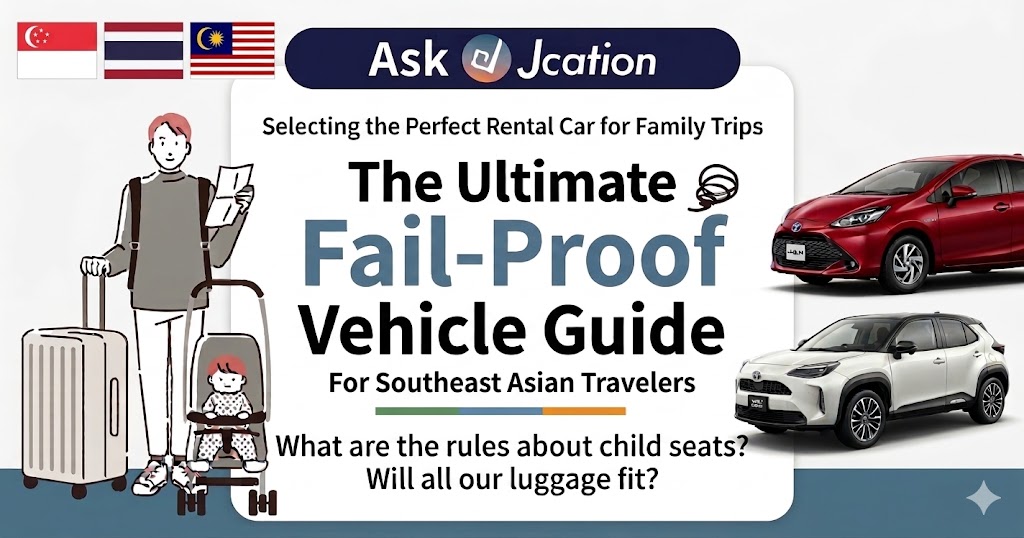
In Southeast Asia, many are accustomed to Japanese cars, but choosing a compact model based on that familiarity can lead to trouble at the rental counter – finding that your “luggage won’t fit” or the “interior is too cramped.” To ensure your entire family travels with a smile, here is the definitive guide to choosing the “correct” rental car in Japan.
1. Comparison: Child Seat Regulations: Japan vs. Southeast Asia
The first step to a successful road trip in Japan is understanding the local rules, Japan is extremely strict regarding safety compliance.
| Item | Japan | Singapore | Thailand | Malaysia |
|---|---|---|---|---|
| Legal Obligation | All children under 6 | All children under 135cm | Under 6 or under 135cm | Under 12 or under 135cm |
| Recommended Standard | Until 140cm tall | Up to 135cm regardless of age. | Follows the law | Follows the law |
| Notes | Very strict enforcement. | Exempt in taxis, but mandatory in rental cars. | Mandated in 2022. Strictness levels similar to Japan. | Mandated in 2020. Has the longest age-based requirement. |
 Concierge
Concierge Advice:
While Japanese law technically ends the requirement at age 6, Jcation’s core value of “Safe & Secure” leads us to strongly recommend using a seat (booster seat) until the child reaches 140cm, similar to Singaporean and Malaysian standards. Don’t just settle for the legal minimum; prioritize your child’s safety in an unfamiliar driving environment.
2. Understanding “Installation Responsibility” in Japan
In Singapore, Thailand, or Malaysia, you might expect a Grab driver or rental staff to proactively help install a child seat. In Japan, however, the culture and law are different.
Under Japanese law, the responsibility for installing a child seat rests solely with the driver of the vehicle.
This isn’t a lack of hospitality; it is a reflection of Japanese business customs and legalities – the shop cannot take legal responsibility for any accidents resulting from improper installation. While this might seem like a hurdle, Jcation’s offering of modern vehicles makes this process simple and stress-free.
3. “Safe & Secure” Travel: Reliability with Vehicles Registered Within 4 Years
Travelers from Southeast Asia often embark on long-distance drives through Hokkaido, Kyushu, or Tohoku. Therefore, vehicle reliability and modern safety features are paramount. Jcation maintains strict listing standards to ensure ease of use and safety.
- Jcation Standards: We exclusively list high-quality vehicles registered within the last 4 years.
- Secure Attachment: While most modern Japanese cars are ISOFIX (LATCH) compatible, rental fleets may stock both “ISOFIX” and “Seatbelt-fixed” child seats depending on inventory. Regardless of the type provided, Jcation’s late-model vehicles ensure a smooth and secure installation based on the latest safety designs.
- Global Safety Standards: The child seats provided by Jcation partners are selected to meet not only the strict JIS (Japanese Industrial Standards) but also globally recognized high-level safety standards.
- Thorough Hygiene Management: Every seat undergoes deep cleaning and sanitization after each rental, a feature highly rated by parents.
4. Jcation Vehicle Selection Guide (By Passengers & Luggage)
To avoid “size shock” when you arrive, here is a breakdown of the vehicle classes available on Jcation.
- Kei Car
- Example: Suzuki Wagon R, Honda N-Box
- Passengers: 2 adults + 1 infant
- Insight: The interior is surprisingly roomy, but the trunk is virtually non-existent. Avoid this class if you have a stroller.
- Compact
- Example: Toyota Yaris, Honda Fit, Toyota Roomy
- Passengers: 2 adults + 1 child
- Insight: High-roof wagons like the “Roomy” feature sliding doors, making loading and unloading children from child seats incredibly smooth.
- Medium
- Example: Toyota Prius, Toyota Corolla Touring
- Passengers: 2 adults + 2 children
- Insight: Stable driving performance that minimizes fatigue on long trips. The luggage space is deep enough to handle standard suitcases well.
- SUV
- Example: Toyota Raize, Toyota Yaris Cross
- Passengers: 2 adults + 1-2 children
- Insight: Japanese SUVs are often one size smaller than those in Southeast Asia. Once a child seat is installed, rear-seat space becomes quite tight.
- Minivan
- Example: Nissan Serena, Toyota Alphard, Toyota Hiace
- Passengers: 4-6 adults
- Insight: The “Correct Answer” for family travel. The Sienta is easy to park, while the Serena offers superb living space. Fold the third-row seats, and it easily fits a mountain of suitcases and strollers.
- Van
- Example: Toyota Probox
- Passengers: 2 adults + heavy luggage
- Insight: This is the legendary “workhorse” of the Japanese business world. While the interior is simple, the flat, massive cargo area is unmatched for carrying bulky items.
5. Why Southeast Asian Travelers Choose Jcation?
Jcation aims for a society where travelers can move through Japan freely and safely. We deliver this through three key pillars.
- Safe & Secure: Quality You Can Trust
- Recent Models Only: All our listed rental cars are registered within the last 4 years and equipped with modern safety features like collision-mitigation braking.
- Verified Partners: We only list companies that meet the strict criteria of the national and prefectural rental car associations and our own rigorous quality standards.
- Transparent Pricing: Zero “Counter Surprises”
- All-in-One Pricing: The price you see is the price you pay, including consumption tax and CDW.
- Unlimited Mileage: No need to track your miles. Explore as far as the road takes you with no extra fees.
- Currency Conversion: Compare prices in AUD or NZD based on real-time daily rates to make budgeting your trip that much easier.
Note: Prices displayed in foreign currency are for reference only. All payments are processed in Japanese Yen (JPY).
- Simple: A Stress-Free Experience
- No Member Sign-Up Needed: Book instantly without having to go through the process of signing up and creating a username and password. All confirmations are sent directly to your email.
- Nationwide Coverage: From major airports like Narita or Haneda to remote Shinkansen stations, Jcation offers extensive pick-up locations and one-way (drop-off) options.
6. Don’t Leave Home Without It! The International Driving Permit (IPD)
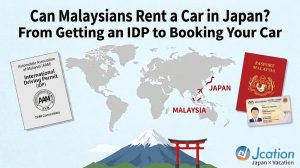
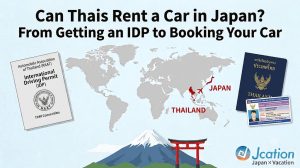
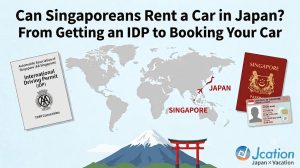
If you are visiting from Singapore, Thailand, or Malaysia, you must obtain an IDP from an authorized body in your home country before departure. Without this, rental counters in Japan will strictly refuse to hand over the keys.
- Singapore Residents: Apply at AA Singapore (Automobile Association of Singapore)
- Thailand Residents: Apply at any Department of Land Transport (DLT) office.
- Malaysian Residents: Apply at any JPJ (Jabatan Pengangkutan Jalan) office.
- Crucial Note: It must be issued under the 1949 Geneva Convention format.
What to Bring to the Counter:
At the counter in Japan, you must present the “Triple Set”: (1) IDP, (2) Your original home country driver’s license, and (3) Your passport.
The Best Memories in the Best Car
At Jcation, we understand that traveling with children who require car seats involves meticulous planning. We want you to enjoy your time in Japan without the unnecessary stress of transportation logistics.
We don’t just provide a “way to get around.” We provide the “peace of mind” that ensures every minute you spend in Japan is rich, safe, and full of smiles.
For your next trip to Japan, find the perfect car to carry your family’s precious memories at Jcation.