The Complete Guide to Car Seats, Vehicle Sizes & Required Documents
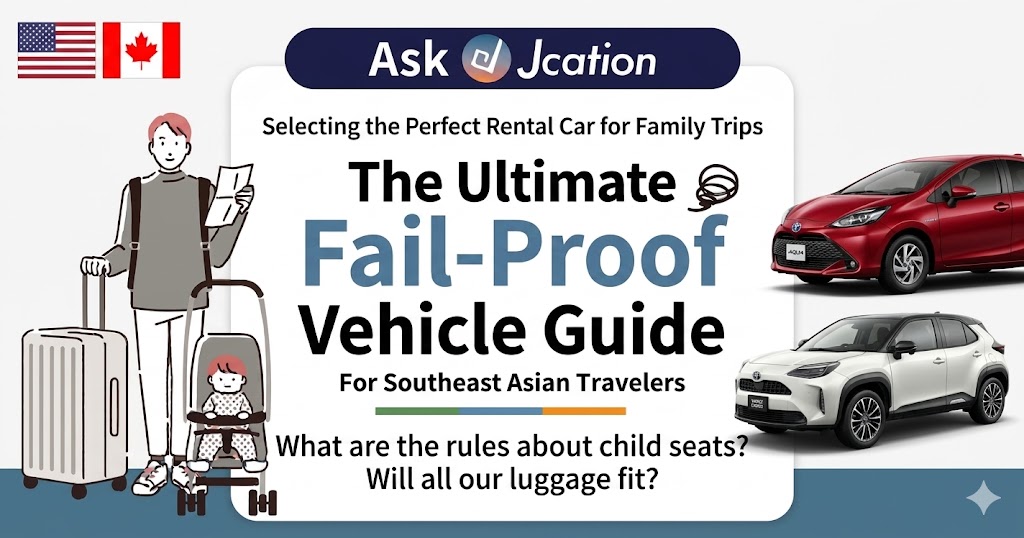
For those of you accustomed to the vast highways of the United States and Canada, the road conditions and rental car selection in Japan might feel a bit different. Especially when traveling with small children, concerns like “Up to what age is a car seat required?” or “Will our large suitcases actually fit?” are common.
As professionals who understand the legal and cultural differences, we are here to ensure that you have the best possible experience on the road in Japan.
1. Comparison: Child Seat Regulations: Japan vs. USA & Canada
There are subtle differences in the mandatory periods and safety regulations between North America and Japan. Let’s compare the requirements.
| Item | Japan | America | Canada |
|---|---|---|---|
| Legal Obligation | Under 6 years old | Generally up to age 8 (varies by state) | Generally up to ages 8-9 (varies by province) |
| Recommended Standard | Until 140cm tall (approx. 10-12 years old) | Until the vehicle seat belt fits correctly. | Until reaching approximately 145cm in height. |
| Notes | ISOFIX. No chest clips. R129 standards are mainstream. | LATCH. Chest clips are standard. FMVSS 213 safety standard. | LATCH/UAS. Chest clips are standard. CMVSS 213 safety standard. |
 Concierge
Concierge Advice:
While Japanese law only requires child car seats until the age of 6, Jcation’s core value of “Safe & Secure” leads us to strongly recommend continued use until your child reaches 140cm (using a booster seat), aligning more closely with North American safety standards.
Note that “chest clips,” common in North America, are not equipped on certified Japanese products because Japanese safety philosophy prioritizes quick extraction in the event of an emergency. While it may feel different at first, rest assured these seats meet rigorous safety standards.
2. Understanding “Installation Responsibility” in Japan
In the US or Canada, you might expect rental staff to help install or check your child seat. However, the culture in Japan is different.
Under Japanese law, the responsibility for correctly installing a child seat rests solely with the driver. Consequently, while rental staff will bring the seat to your vehicle, they generally will not perform the installation for you. This is not a lack of service; it is a standard practice based on legal liability. The modern fleet available on Jcation makes this process easy, but it is important to be prepared to secure the seat yourself.
3. “Safe & Secure” Travel: Reliability with Vehicles Registered Within 4 Years
Jcation maintains strict listing standards to ensure ease of use and maximum safety.
- Jcation Standards: We exclusively list high-quality vehicles registered within the last 4 years.
- Secure Attachment: While most modern Japanese cars are ISOFIX (LATCH) compatible, rental fleets may stock both “ISOFIX” and “Seatbelt-fixed” child seats depending on inventory. Regardless of the type provided, Jcation’s late-model vehicles ensure a smooth and secure installation based on the latest safety designs.
- Global Safety Standards: The child seats provided by Jcation partners are selected to meet not only the strict JIS (Japanese Industrial Standards) but also globally recognized high-level safety standards.
- Thorough Hygiene Management: Every seat undergoes deep cleaning and sanitization after each rental, a feature highly rated by parents.
4. Jcation Vehicle Selection Guide (By Passengers & Luggage)
If you choose a car based on North American “Full-size SUV” standards, you may find that all your luggage won’t fit. Here is a guide to the vehicle classes available on Jcation.
- Kei Car
- Example: Suzuki Wagon R, Honda N-Box
- Passengers: 1-2 people
- Insight: A unique Japanese 660cc category. Smaller than anything in the US. With a child seat, luggage space virtually disappears.
- Compact
- Example: Toyota Yaris, Honda Fit, Toyota Roomy
- Passengers: 2-3 people
- Insight: Equivalent to a “Subcompact” in North America. Ideal for 2 adults and 1 child.
- Medium
- Example: Toyota Prius, Toyota Corolla Touring
- Passengers: 3-4 people
- Insight: Equivalent to an “Intermediate.” Many are hybrids (like the Prius), offering stability for long-distance or highway driving.
- SUV
- Example: Toyota Raize, Toyota Yaris Cross
- Passengers: 2-3 people
- Insight: “Crossover” size. Offers a higher vantage for narrow Japanese roads, but interior space is similar to the Compact class.
- Minivan
- Example: Nissan Serena, Toyota Alphard, Toyota Hiace
- Passengers: 4-6 people
- Insight: The “Golden Choice” for North American families. If you have 2 child seats and 3+ large bags, a mid-size minivan (like the Serena) is essential for comfort.
- Van
- Example: Toyota Probox
- Passengers: 2 people
- Insight: Commercial vans. The interior is basic, but the cargo capacity with the rear seats down is incredible.
5. Why Choose Jcation?
Jcation aims for a society where travelers can move through Japan freely and safely. We deliver this through three key pillars.
- Safe & Secure: Quality You Can Trust
- Recent Models Only: All our listed rental cars are registered within the last 4 years and equipped with modern safety features like collision-mitigation braking.
- Verified Partners: We only list companies that meet the strict criteria of the national and prefectural rental car associations and our own rigorous quality standards.
- Transparent Pricing: Zero “Counter Surprises”
- All-in-One Pricing: The price you see is the price you pay, including consumption tax and CDW.
- Unlimited Mileage: No need to track your miles. Explore as far as the road takes you with no extra fees.
- Currency Conversion: Compare prices in USD or CAD based on real-time daily rates to make budgeting your trip that much easier.
Note: Prices displayed in foreign currency are for reference only. All payments are processed in Japanese Yen (JPY).
- Simple: A Stress-Free Experience
- No Member Sign-Up Needed: Book instantly without having to go through the process of signing up and creating a username and password. All confirmations are sent directly to your email.
- Nationwide Coverage: From major airports like Narita or Haneda to remote Shinkansen stations, Jcation offers extensive pick-up locations and one-way (drop-off) options.
6. Don’t Leave Home Without It! The International Driving Permit (IPD)
If you hold a US or Canadian driver’s license, you must obtain an International Driving Permit (IDP) before departing for Japan. Without this, rental counters will strictly refuse your rental – no exceptions.
- USA Residents: Obtain your IDP from AAA (American Automobile Association)
- Canada Residents: Obtain your IDP from CAA (Canadian Automobile Association)
- Crucial Note: It must be in the format based on the 1949 Geneva Convention.
What to Bring to the Counter:
At the counter in Japan, you must present the “Triple Set”: (1) IDP, (2) Your original home country driver’s license, and (3) Your passport.
ConciergeConcierge Warning:
The assumption that “my state/provincial license is globally recognized” is the biggest pitfall for travelers to Japan. Please ensure you complete the paperwork at your local AAA/CAA office in advance.
A Grand Adventure in Japan With Total Peace of Mind
Driving on the left side of the road or navigating narrow alleys might require a bit of courage. However, with the right documentation, a safe and secure car seat for your child, and enough space for the whole family to relax, that anxiety turns into the joy of “exploration.”
Jcation is here to help you find the perfect vehicle to traverse Japan’s beautiful landscapes. If you have any concerns about child seat compatibility or luggage, please feel free to contact us anytime.